
Git and Change Management for IBM i
Git and Change Management Working Together on IBM i
Git allows you to manage all source code, including IBM i native source (like RPG), alongside other languages like Java, PHP, or Node.js, within a single repository. This simplifies source code management and makes coordination across different IT teams much easier.
By combining the complementary strengths of Git for source management with an IBM i-specific change management solution like MDChange, you can achieve the best of both worlds. fast, collaborative development and safe, controlled deployments.
Bridge the Gap
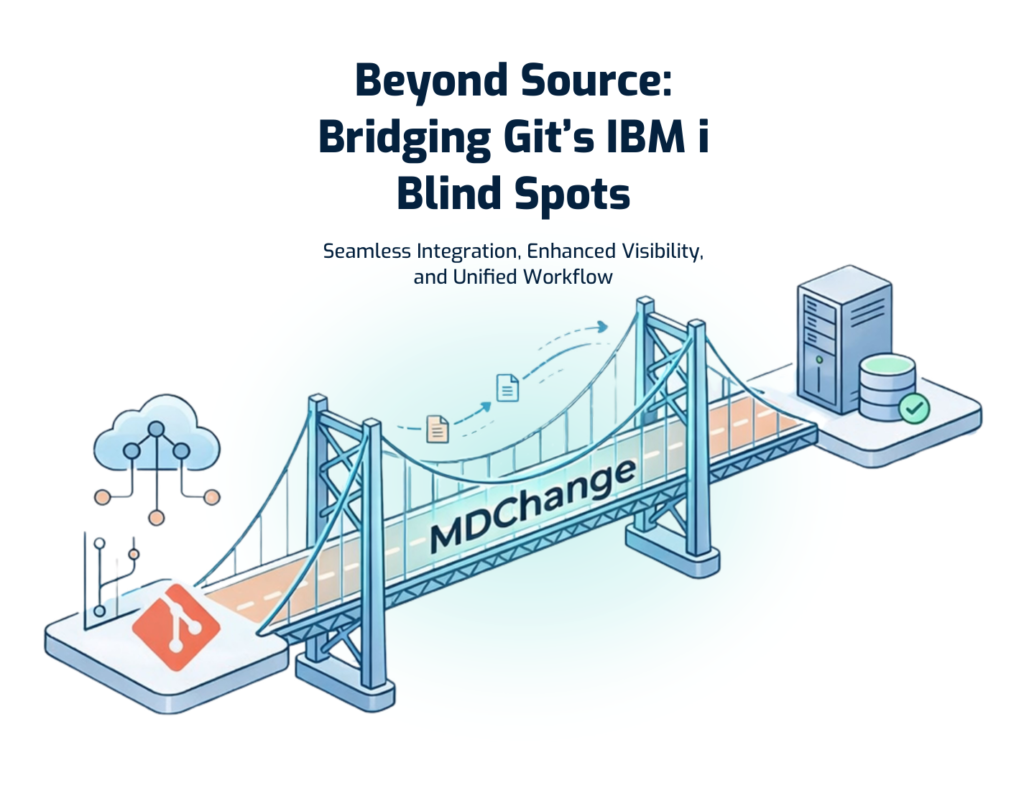
We understand the challenge: while Git excels at managing source code, it has no native understanding of IBM i’s unique ecosystem. Git-based source control systems cannot handle the object types, file extensions, and related executables essential to IBM i-based applications.
MDChange provides powerful support for IBM i Git users and automates the DevOps workflow. IT teams can embrace DevOps practices, maintain full compliance, and keep development and production environments in sync without sacrificing performance or reliability.
Automate Git Branch Creation
Automatically create Git feature branches based on task creation, approval, state transitions, or manual triggers. MDChange ensures that every change request gets its own isolated development branch with consistent naming conventions.
Create Feature-Branch Test Environments
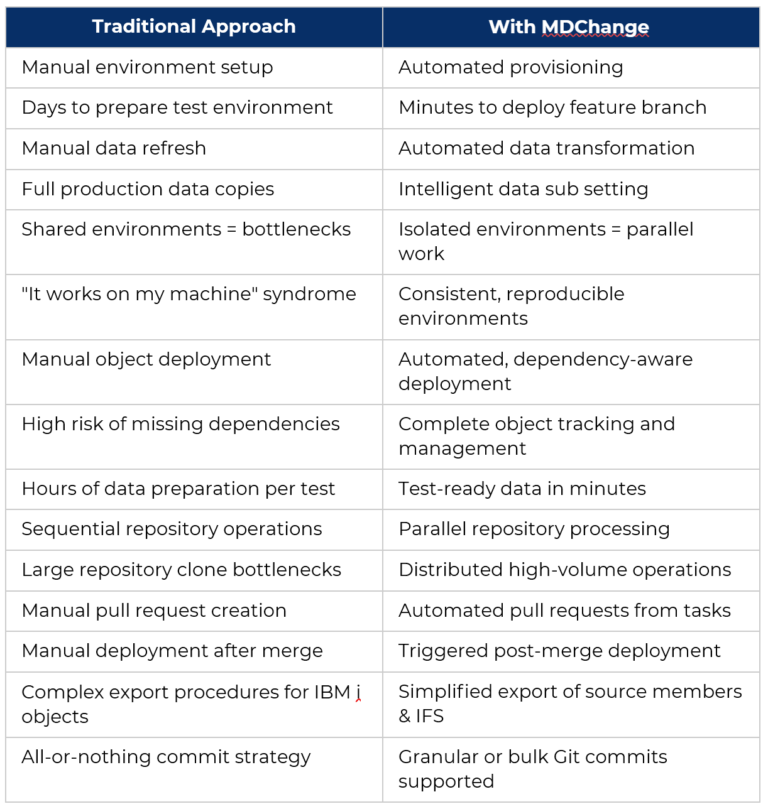
MDChange can provide IBM i environments for each feature branch, maintaining libraries, IFS folders, test data, and all dependencies. It enables parallel development and testing without conflicts, matching container-based workflows used by cross-platform teams.
Simplify Export of Source Members and IFS Directories into Git
Users benefit from streamlined export capabilities through the MDSRC2IFS command and VS Code/RDi integration. MDChange automatically converts source members to UTF-8, normalizes line endings, and enables one-click IFS directory exports to Git with configurable filtering and branch management.
Optimize Git Repository Cloning
Automatically distribute high-volume Git operations across service jobs with intelligent load balancing, enabling parallel processing from multiple repositories to eliminate bottlenecks during large clones and multi-developer branch operations.
Automate Pull Requests
Bi-directional integration automatically creates and manages Git pull requests upon successful environment promotions, with fully customizable tags and configurable target branches for multiple merge levels.
Seamless Project Management Integration
Integrate directly with Azure DevOps, ServiceNow, and Jira to automatically synchronize task status throughout the development lifecycle. This eliminates manual updates and provides real-time visibility to project managers and stakeholders.
Post Merge Deployment Triggering
MDChange can be triggered via webhook by successful Git merges to automatically start cross-platform deployment pipelines. It creates complete feature branch deployment sets including all non-Git components while tracking the original change request.
Granular, Time-Sensitive Deployments
Enable feature-based deployments on independent schedules rather than requiring monolithic maintenance windows, providing tracking and audit trails, MDRapid, our rapid database update solution, provides data conversions while keeping production systems live until planned switches.
Automatic Rollback and Risk Mitigation
Automatic, object-level rollback capabilities instantly revert to previous stable states if deployment errors occur, reducing deployment risk and enabling frequent releases with confidence.
Cross-Platform Deployment
MDChange coordinates with external CI/CD systems to ensure IBM i and non-IBM i components deploy simultaneously with atomic transactions, automatically rolling back both platforms if either deployment fails.
Bidirectional Enterprise Integration
REST APIs in MDChange enable true bidirectional communication with enterprise CI/CD pipelines, receiving triggers from external systems and sending status updates, making IBM i a first-class citizen in enterprise DevOps workflows.
Real World Impact